NO PHOTOS
Reflections on a Moroccan Theme.
I walk away sheepishly, an act I fear is becoming a pattern. A theme. A Moroccan theme nevertheless. Can I include it in the list of places that are difficult to photograph? I certainly think so. Bruno Barbey once said, “It is very difficult to photograph there, because in Islam photography is supposed to bring the evil eye.…) “You have to be cunning as a fox, well-organized, and respect some customs. The photographer must learn to merge into the walls. Photos must either be taken swiftly, with all the attendant risks, or only after long periods of infinite patience. Such was the price of these images… The memory of Morocco can only be captured with respect.”
While I agree with his emphasis on photographing with respect, being sensitive to customs, and much of what he said...), I also do not agree with his views on the evil eye! Perhaps my being a practicing muslim gives me some semblance and understanding of my own religion. In Islam, schools of thought exist, and these certainly have their views on photography. Some are against image making. However, my inclination is more in line with a Fatwa, (a legal edict in Islam) by Sheikh Yusuf Al-Qaradawi a scholar who has done more work relating to issues with the modern world. He represented the more permissive view. In his famous work, The Lawful and the Prohibited in Islam, he argues that “the necessity and benefit of photography for IDs, passports, education, documentation, and preserving memories makes it permissible, as long as it is not for sinful purposes”.
There are thus prohibitions, more related to the type of photography that one engages in or the subjects one chooses. But besides that, an evil eye is certainly not something I am concerned with. Perhaps Bruno Barbey was talking more about local customs. For I certainly found taking images in Morocco extremely difficult. These are my impressions.
I walk away sheepishly, an act I fear is becoming a pattern. A theme. A Moroccan theme nevertheless. Can I include it in the list of places that are difficult to photograph? I certainly think so. Bruno Barbey once said, “It is very difficult to photograph there, because in Islam photography is supposed to bring the evil eye.…) “You have to be cunning as a fox, well-organized, and respect some customs. The photographer must learn to merge into the walls. Photos must either be taken swiftly, with all the attendant risks, or only after long periods of infinite patience. Such was the price of these images… The memory of Morocco can only be captured with respect.”
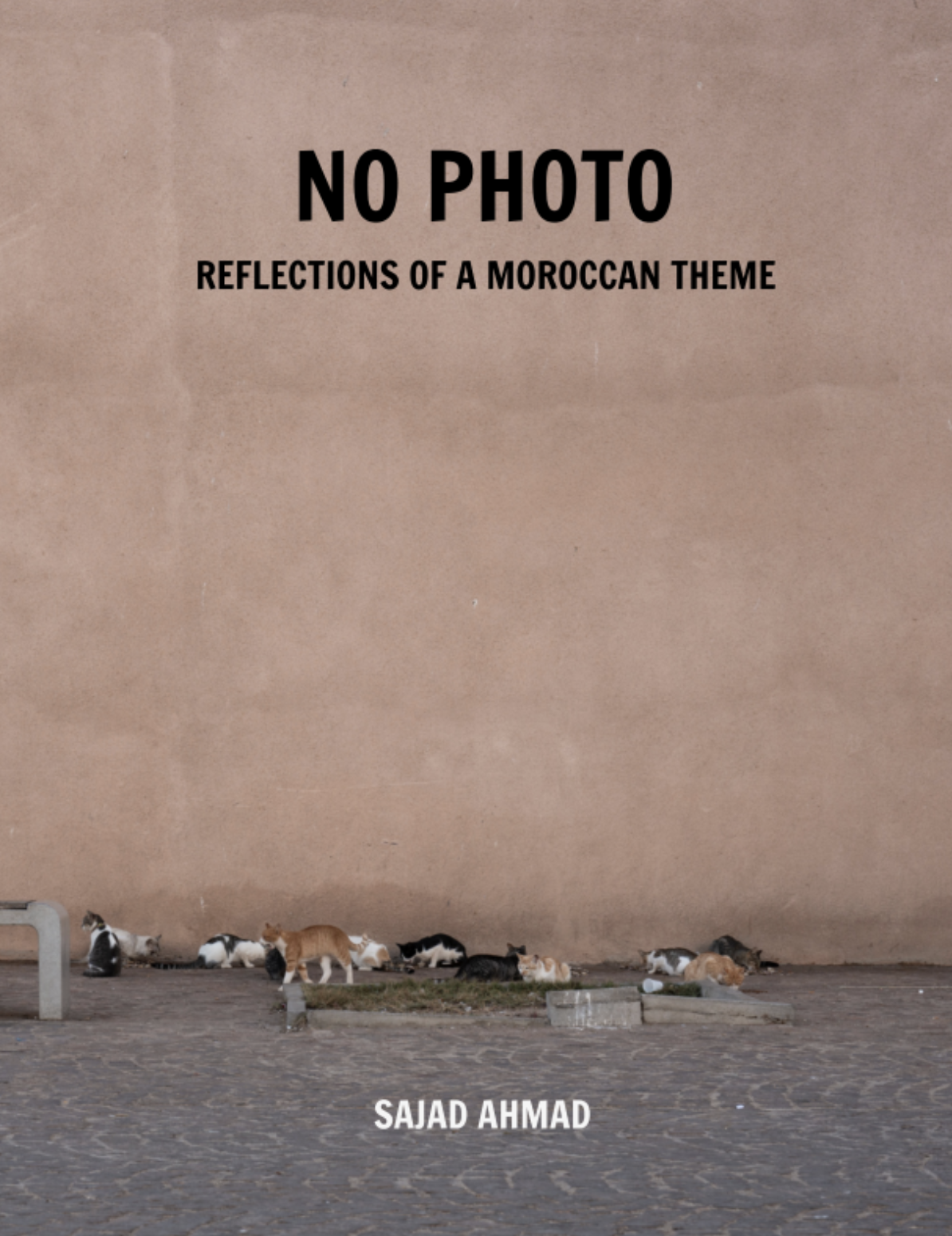
I start to question the subjects whom I try to photograph in the streets. For me, being fluent in Arabic is a bonus. I suddenly find myself becoming more engaged. Photography, documentary and street photography here is becoming a debate with the locals. Starting with the famous words that nearly every subject utters; NO PHOTO. My response, either walk away or try to debate by beginning to sweet talk, in Arabic. until they ask me, “Min wain” [From where?…(Are you from)]. Here, I change my allegiance, conveniently! "Pakistan, I say." Then comes the second statement, “You speak Arabic!” Most Pakistanis don’t, and they know this. To me this is an entry point of chatting further, Now I feel I have an opportunity to enter their world.
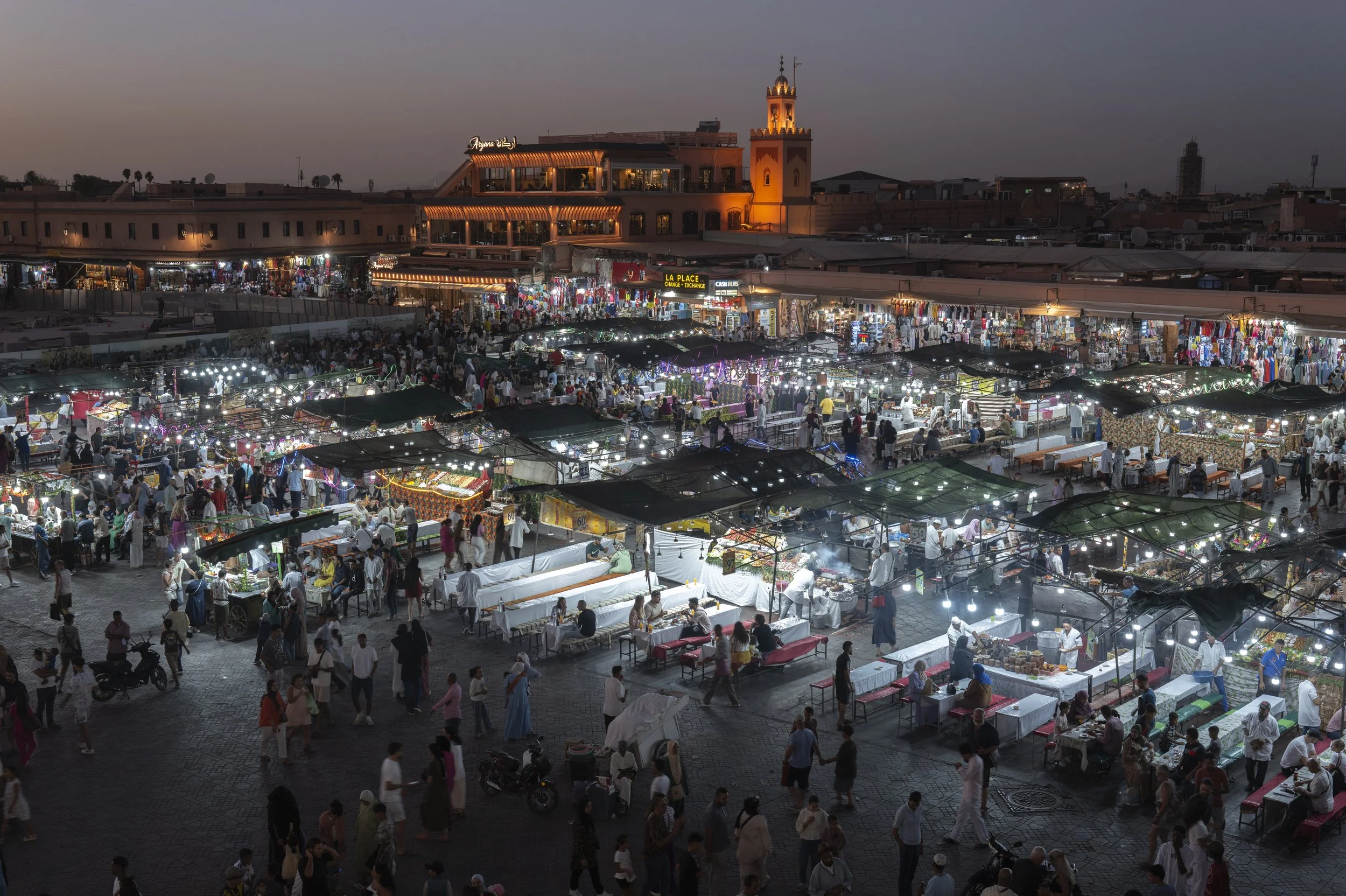
Morocco is wild, Untamed, Don’t let its calmness outside the chaos make you believe otherwise. It sits on the borders of the Sahara desert, of scouring winds. Of beaches where the grain of sand blown against my skin feels like tiny thorns etching memories of its being. The seaside town of Essaouira seems calmer than the chaos and busyness of the Medina in Marrakech. My room here feels humid. Our riad here backs to the jaw dropping views of the Atlantic ocean. I can taste the salt in the air. The effects of the sea are obvious, the first thing I notice is the tall wall surrounding the medina. Built in 1760 by Mohammed III it adds to fortifications from wind more than from outside invaders. I wonder here if he knew the benefits it would provide to Medina centuries later. Houses here are more than just homes; they are also businesses. Many turned into riads, inner courtyards still providing a sanctuary, this time to the tourists. A short walk through the winding alleys is the square. A natural place of gathering made such by the beautiful eateries, white washed facades some with a blue hue make them seem isolated and cold, cut off from the rest of Morocco.
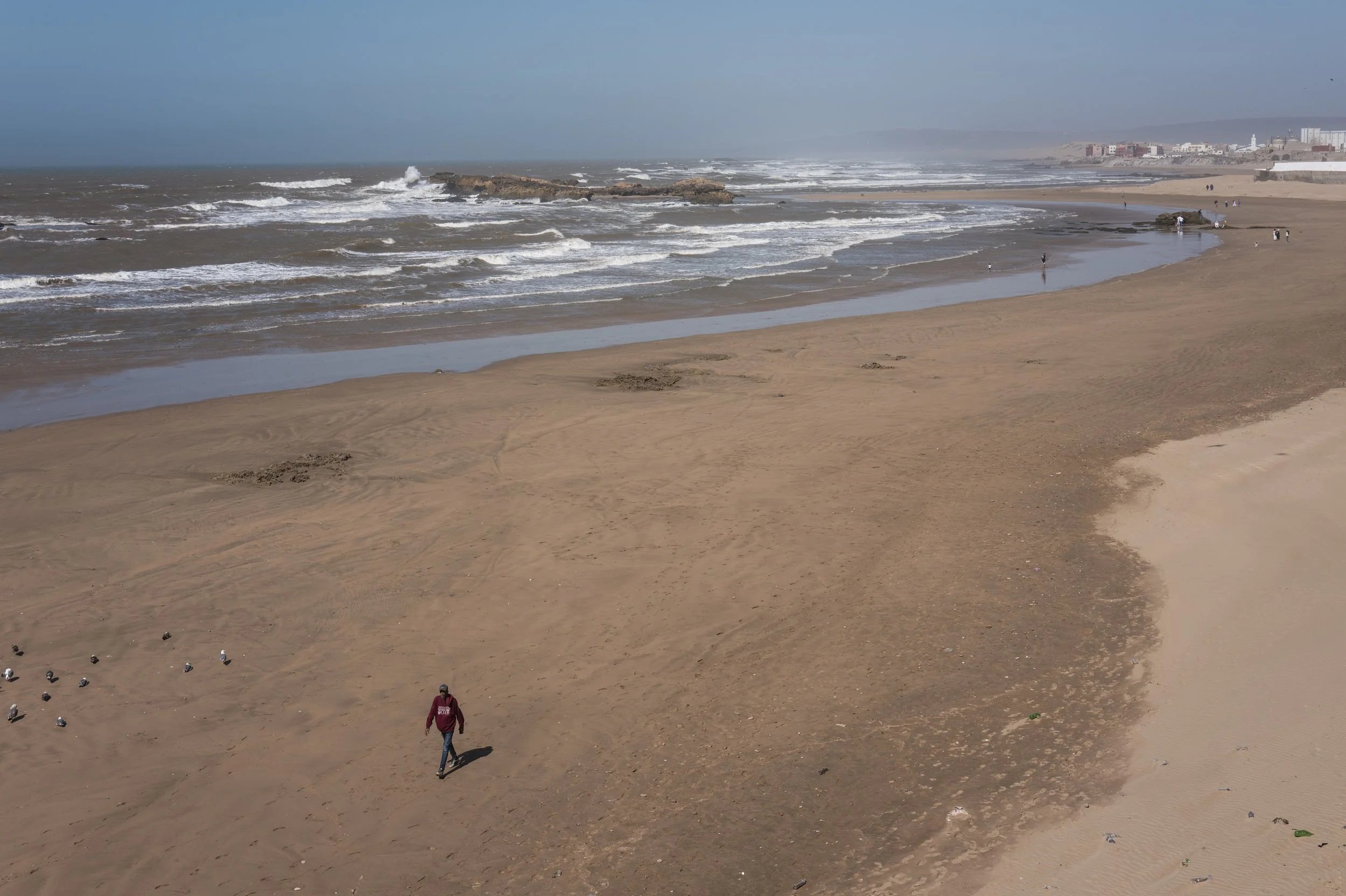
The seaside town of Essaouira seems calmer than the chaos and busyness of the Medina in Marrakech. My room here feels humid. Our riad here backs to the jaw dropping views of the Atlantic ocean
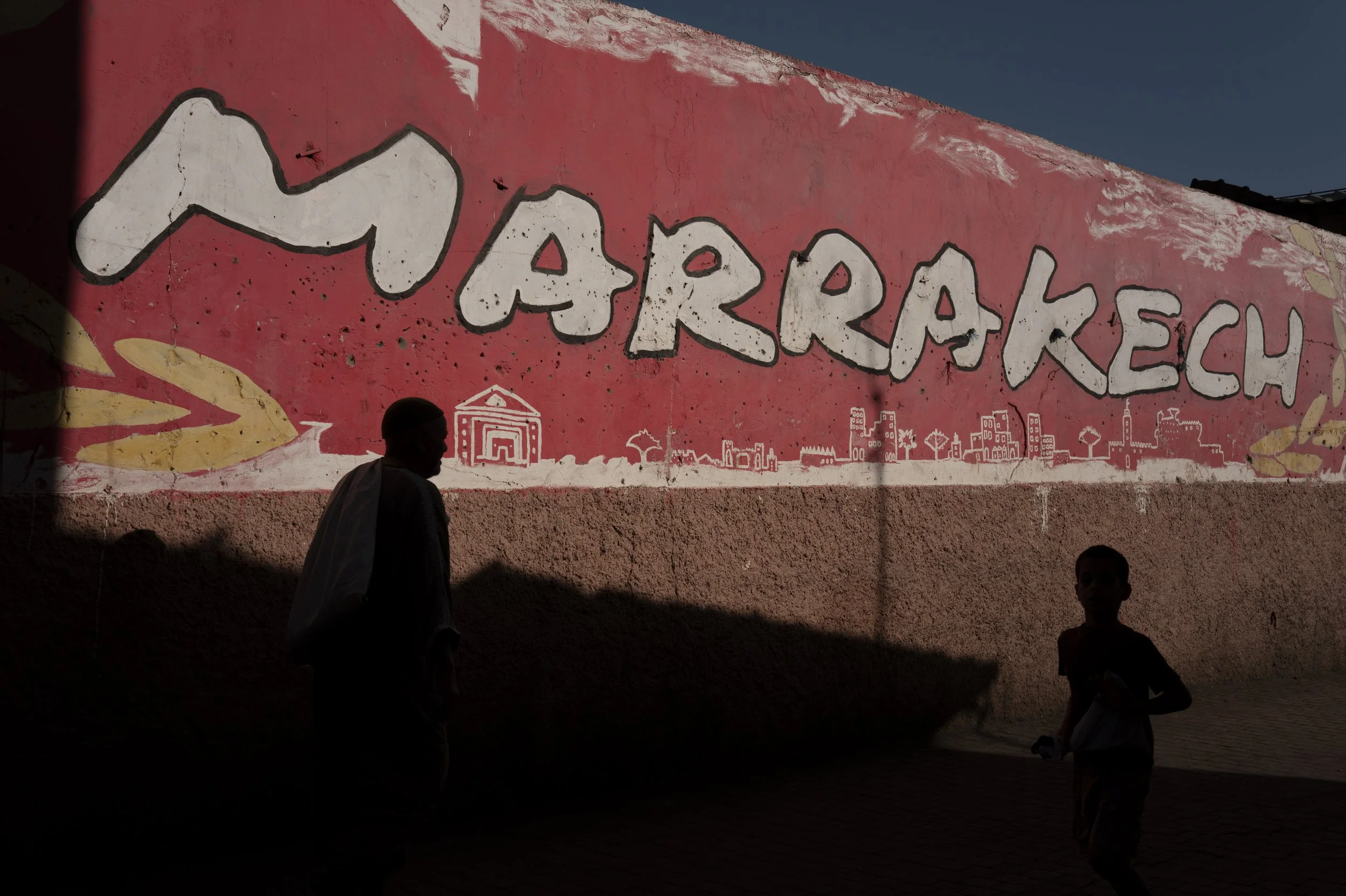
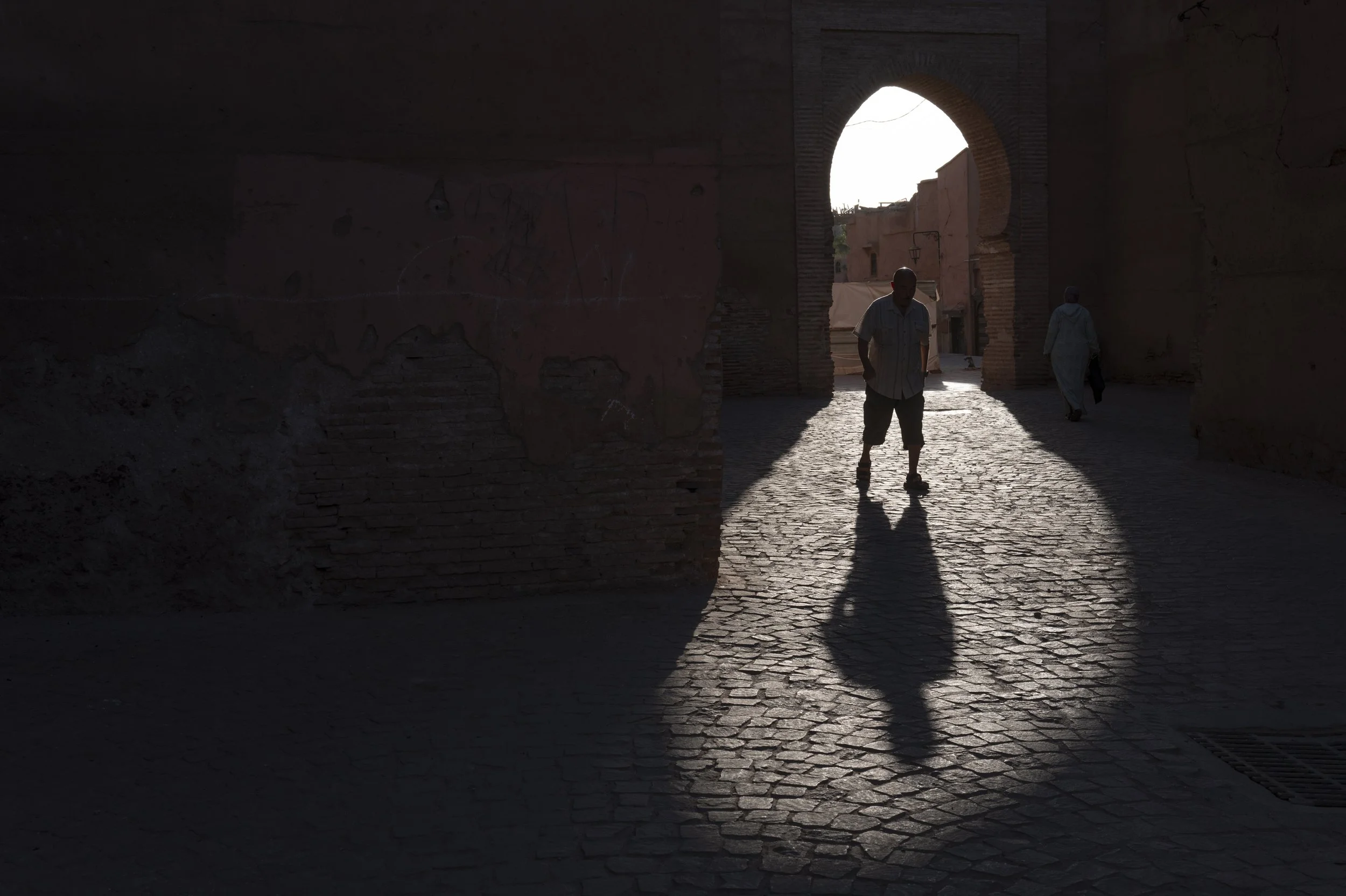
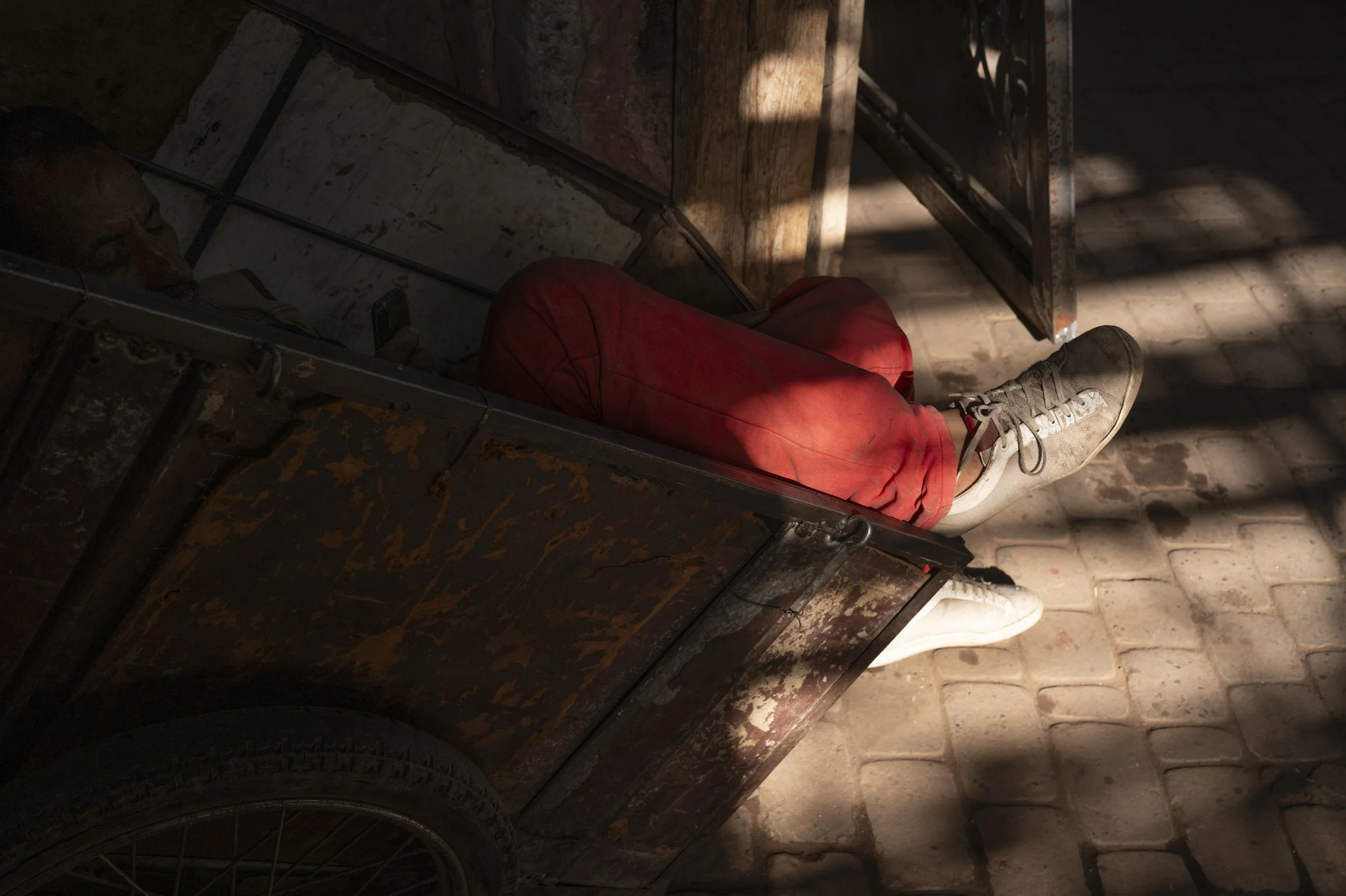
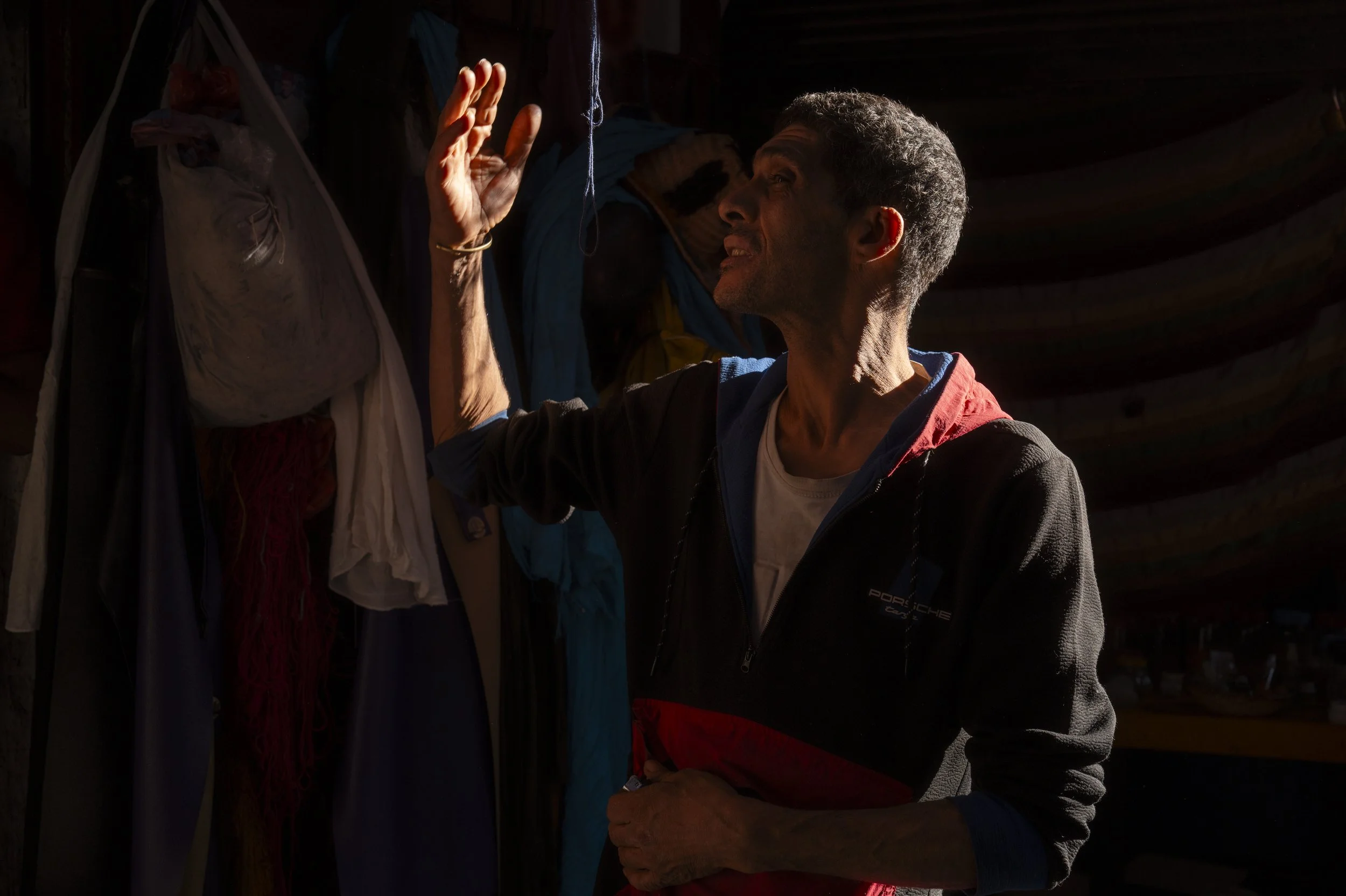
Marrakesh, in contrast, is red with warmer hues. I find the people difficult to photograph in both places, but there is a slight feel that perhaps Essaouira is a little easy to document, it doesn’t take long when I develop a pattern, recognising compositions worth the extra effort. I have a story I feel, my gradual exploration starting with Marrakech, from its shadows, silhouettes and warmer colours seem to blend into the faces of Essaouira. I cannot help but feel, the gradual confined feeling turns into a welcome embrace. Perhaps restricted to the confines of cultural sensitivities, I still feel I can get away with a few snaps when seeing a few friendly faces. Deep in the Medina of Marrakech, I meet Molouf Abd-ul-Latif, a wrought iron artist. In the alleyways behind his workshop are a series of shops used for dyeing wool, colours complementing shadows, workers here seem like characters from a stage play. Perhaps life here is no less, full of tragedy, sustained difficulty complemented by centuries old resilience adding to the drama of life. It is a reflection of what reality is like for most people.
At the edge of Essaouira I meet Omar. He lovingly talks about his Horse, Qamar (An Arabic word for the moon). He tells me, She is beautiful just like the moon. "No doubt I say, “mothers often call their children Qamar” because of the same sentiment. Perhaps for him his horse is like his child. “How old is she?” I ask, “20 years”.
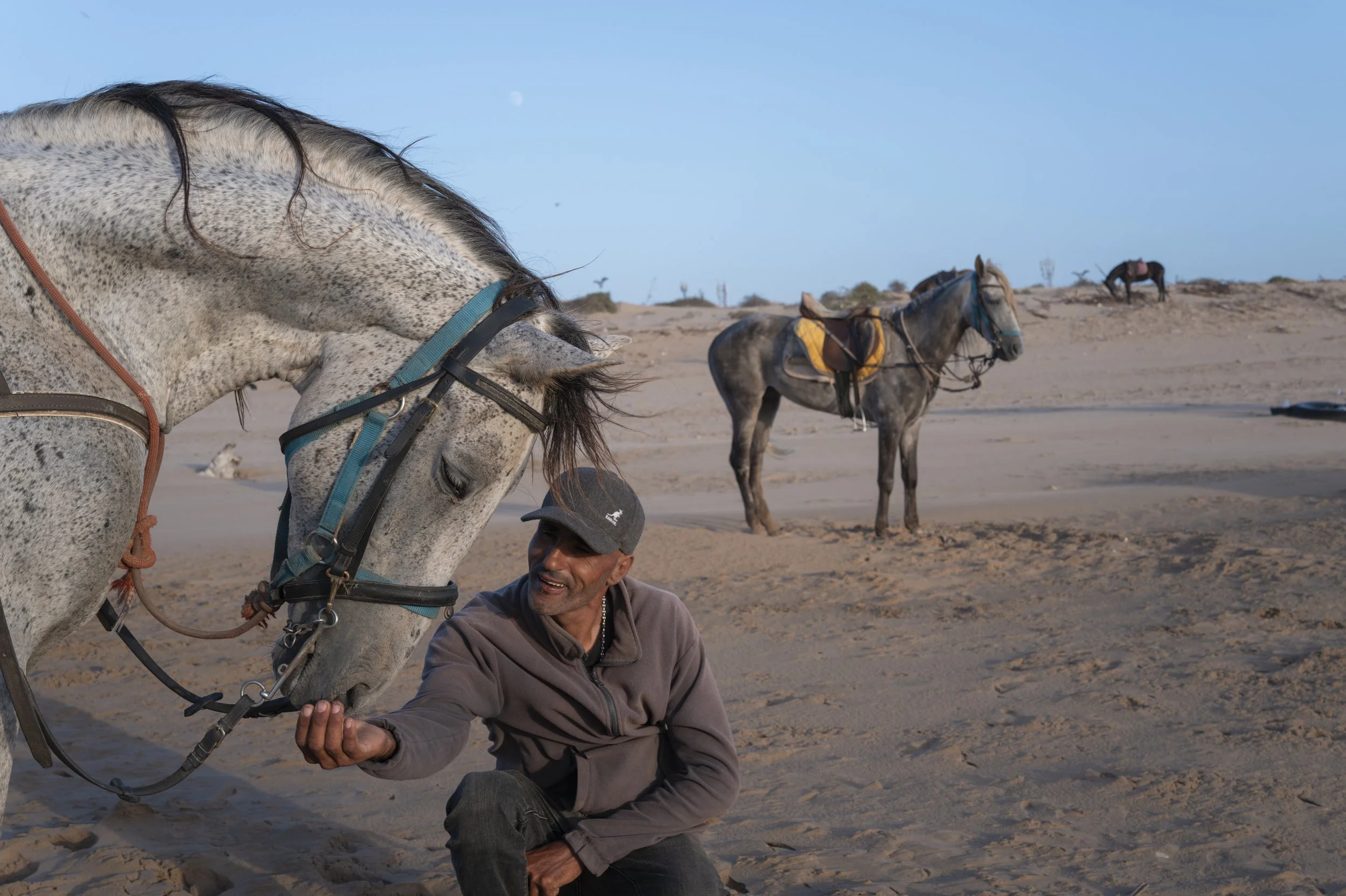
Here the strong winds are more obvious, the grain of sand making its presence felt, I turn my back towards it, feeling the discomfort I start looking for a place of refuge, Omar seems unfazed by this as he starts playing with his dog. Extending his hand his dog does the same and they shake hands. He laughs at this and says to me, “see, he is shaking my hand”. I can see the love he has for his animals. In Morocco animals are part of the family. Moroccans are resilient. They are reliant on their own beliefs. The belief in God. Alhamdulillah (Praise and Thanks be to God) is heard often.
They have seen centuries of exposure to foreign influences. Been the rulers of an empire for nearly a thousand years. Influenced Europe with their culture, yet, they have had no issues maintaining their own identity. This amazes me the most. While at breakfast I eat French pastries, drinking espresso, it’s the orange juice, and the semolina pancakes that remind me what the Moors introduced to Europe. They may be part of Africa, but to me the Moroccans are a global people. They truly are citizens of the world.
When I started walking through the streets of both cities, I had no idea of what the vastness of Morocco meant to the outsider. My time here has taught me what humanity feels like, Loneliness seemingly haunts the cities, covered by walls and citadels the inhabitants seem cut off from the towns outside. But, it’s the humbling gestures of sharing mint tea, the welcome embrace in many languages, groups sitting together recounting the stories of the day. Evening meals over the sound of the call to prayer echoing from the minarets of dozens of mosques that turns the silence of desert into a living breathing city. Where the sand shifting across winds eludes the breath it’s land takes. Photographing Morocco should be taken as a privilege. It is not a place for a one off visit, It is a place that requires careful consideration. Of careful narrative building. It is a place that for me, along with my other projects have become a challenge, wanting to visit again and again.
Watch the Accompanying Video
This project began with two words: "No Photo." But what happens when you speak the language? When you stay long enough to move from a tourist to a guest? This video is the answer. It's a visual dialogue with Morocco, from the chaotic red hues of Marrakesh to the wind-swept, blue-washed walls of Essaouira. Through these frames, I explore the tension between loneliness and embrace, the historical and the everyday, and the profound humanity that defines this incredible country. This is Morocco, seen through the lens of patience and conversation.
Support my projects, Purchase the Morocco zine from blurb on the link -